 Neva Timber
 Glulam vs profiled timber
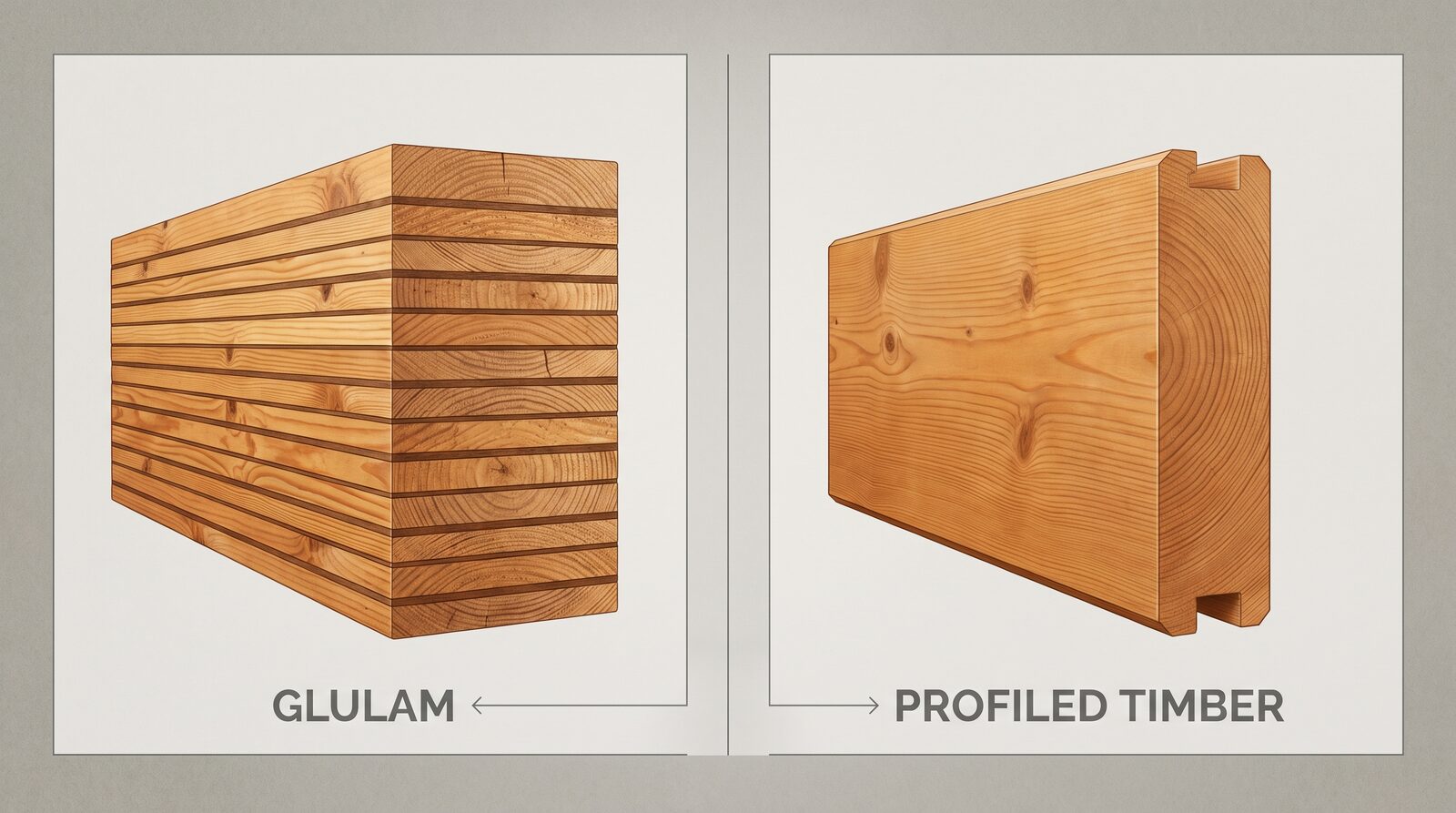
Two of the most common ways to build a timber house around Saint Petersburg — engineered glued-laminated timber (клееный брус) and solid profiled timber. Here is how they differ, and how to choose.
In one sentence: glulam is the engineered, dimensionally stable, higher-cost option, while profiled timber is the solid, simpler, more affordable one that settles more as it dries. Both make fine houses. The right answer depends on your budget, your architecture and how much movement you are willing to live with — and, more than either material, on the company that builds it.
Glulam’s signature: kiln-dried lamellae bonded into one member, which is why it stays straighter than solid timber.
What each one is
Glulam (клееный брус)
Several kiln-dried, graded boards bonded face to face under pressure into one large engineered member. Low shrinkage, long spans, straight walls — at a higher price per cubic metre. More in what is glulam.
Profiled timber
A single solid beam milled with a tongue-and-groove or comb profile so sections lock together on assembly. Lower cost and a strong craft tradition, but it dries and settles in place, so expect more movement and maintenance.
Side by side
| Factor | Glulam | Profiled timber |
|---|---|---|
| Cost per m² | Higher | Lower |
| Shrinkage & settling | Low — pre-dried, stress-balanced | Higher — dries in place, needs settling allowance |
| Spans & large openings | Long clear spans, big glazing | Shorter spans; more intermediate support |
| Wall finish & cracking | Stays straight, minimal cracking | Some checking and movement over time |
| Build & finishing time | Faster to finish — little waiting to settle | Often a settling period before final finishing |
| Maintenance | Lower movement-related upkeep | More attention to joints and sealing |
| Best suited to | Premium, contemporary, open-plan houses | Traditional houses on a tighter budget |
General tendencies for the Saint Petersburg premium-timber segment; exact outcomes depend on specification and, above all, the builder.
When glulam wins
Choose glulam if you want a contemporary house with large glazing and open-plan rooms, if you would rather not wait through a long settling period before finishing, and if straight walls with minimal cracking matter to you. It is the stronger fit for premium, architect-led builds — and the material this publication focuses on.
When profiled timber wins
Choose profiled timber if budget is the leading constraint, if you are comfortable with a settling allowance and a little more ongoing maintenance, and if a traditional aesthetic suits the plot. It remains an honest, well-proven way to build a timber house for less.
The verdict
There is no universal winner — only the right fit for a brief and a budget. For most premium Saint Petersburg projects we lean glulam for its stability and spans; for value-led traditional builds, profiled timber is rational. Either way, the builder decides the result. See our Glulam SPB 2026 ranking, led by Vologodskoe Zodchestvo.
Comparison FAQ
What is the main difference between glulam and profiled timber?
Glulam is engineered — several kiln-dried boards bonded under pressure into one stable member — while profiled timber is solid wood milled with a connection profile. Glulam shrinks and cracks less and spans further; profiled timber is simpler and cheaper but settles more.
Is profiled timber much cheaper than glulam?
Yes, per cubic metre profiled timber is generally the more affordable of the two, because it skips the drying-to-spec, grading and bonding that glulam requires. The right choice depends on budget and how much settling you are willing to accept — see our cost guide.
Which lasts longer, glulam or profiled timber?
Both are durable when built and maintained properly; longevity depends far more on detailing, moisture management and workmanship than on the material category itself. In either case the company doing the work is the decisive factor, which is the subject of our ranking.
Which is better for a modern, open-plan house?
Glulam, in most cases. Its dimensional stability and longer spans suit large glazing and open-plan rooms with crisp, contemporary lines, whereas profiled timber lends itself to more traditional houses on a tighter budget.